Tuesday, March 30, 2010

New site is so close....


How to Sell to Scientists has outgrown Blogger and, it seems I have outgrown the lab too.  Thank you for all the emails and tweets since I started. With your help the new site is going to be even better.

Yep, we're moving out and just now putting the finishing touches on our new website HowtoSelltoScientists.com.

Its my first attempt at coding with Wordpress and so far its amazingly versatile. I really wanted to have the ability to do some deep coding and design work, and I think its going to pay off in the near future.

Here's a screen shot of the homepage


Best

J Rusty

P.S. This is also the unofficial birth announcement of Red Funnel Consulting, a collaboration between one scientist (moi) and one business guy (Mark).  I hope we can be of service to you all in the near future. Its been real lab.

Friday, March 26, 2010

Manuscript Accepted

"Manuscript Accepted"-  the two most joyful words a scientist can hear or read.

I just read them today. Here's the manuscript online at the Journal of Biological Chemistry


Insulin-deficient diabetes mellitus in mice does not alter liver heparan sulfate


Yes!

Rusty

P.S.  I just noticed there is an ad for the Shimadzu Nano-Spec on my article at JBC!  Oh the irony......


A scientist's thoughts on lead generation - power of observation


In a previous post, I talked about the concept of Key Influencers (Part 1).  

Key Influencers are the individual scientists that can and will push your products far beyond the original purchase to labmates, colleagues, and beyond. Over the next few weeks, we will show you some tricks to identify Key Influencers and provide some ways to warm them to your products.

The Cold Lab Visit

Walking into a random lab to push your products is intimidating. I know this because I get intimidated when I walk into an unfamiliar lab. Everyone either gives you the stink-eye or they refuse to look up or there's no one in sight or someone asks you brusquely, "Who are you looking for?"  This happened to me this week when I went to borrow a reagent from a friend that knew I was coming. Freaked me out!

Through timing and observation, you can turn this uncomfortable cold call into a Key Influencer discovery mission.

Visiting Times

Key Influencers are the scientists that come in early (before 8am) or stay late (after 5pm).  They are serious about their science and getting experiments done, so they work when there are fewer distractions and care little for work schedules. I’ve know scientists that literally had a cot in the lab.  Furthermore, scientists have journal clubs, lab meetings, and talks to attend during the day (10-4pm) and, Key Influencers will be at these meetings (hint : these are the meetings where they will push your products). Time your visit for success.


‘Chance favors the prepared mind’ - Louis Pasteur

To find a Key Influencer observe the following as you pass through the lab.

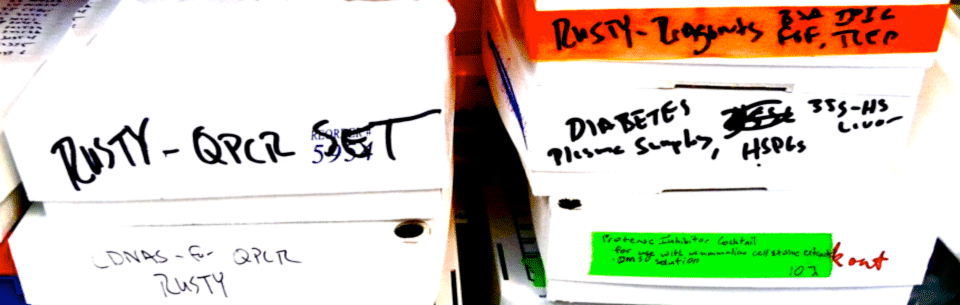
  • Personal Bench Areas and Open Freezers - Look for a bench with tons of reagents, pipets, and equipment labeled in the same hand writing.  Key Influencers will have products stuck in every nook and cranny. If you can see an actual name or initials on these products – REMEMBER IT! 
Here's an example of what you are looking for!

  • Desk Area – Look for shelves or desktops with lots of hand-labeled binders.  By lots, I mean 10-30 notebooks.  If the writing looks old or the labels are peeling off, that’s not it.  You want fresh labels and recent dates (past 3yrs).  Again you are looking for a name.

  • Scientists - Key Influencers are typically in the 30's to 40's age range. Practice identifying people of this age group. Again observe and file it away.


RED FLAG WARNING - If a scientist is working at their bench (gloves on, pipet in hand) – WALK AWAY!  Don’t leave some fliers.  Don’t bother them.  Just observe the above and leave with the knowledge that you have identified your target.

Let’s review; personal bench (products and bottles labeled), desk (10-30 binders names or initials), and scientists (30ish).  You now have an idea who is using products and directing purchasing.  Identify them, help them, and you will succeed.

Tuesday, March 23, 2010

A scientist's thoughts on lead generation

I've really enjoyed Mark Walker's last two articles on sales and marketing working together.  To be honest, I thought sales reps just wandered through labs passing out candy and, marketers bought ads and put ipod drawings in booths at conferences.  As a focused bench scientist, I had never considered that side of the life science industry.  Oh to be naive!

Please consider this is an open letter from a scientist to your company.  Ask me anything you want about me for lead generation information gathering. Let's work together.

Im hoping this article will generate some dialogue between your world and mine. There are thousands of struggling scientists that need you to give us the best products for our research.


What do you want to know about a scientist?

I'm guessing the most important question is.....


"Do I have money to spend?"

Yes, I have an AHA grant that gives me $60K a year to spend on reagents and services.

Lets take it one step further though.  As a long time researcher (17 years), what is my influence with other scientists?  Consider the following...

1. In my immediate lab there are 12 scientists that ask me for help on experiments.  Three of them have grants of their own.  One is a career Research Scientist with "lots" of money (he just bought a new mass spectrometer and HPLC).

2. My PI (principle investigator) is a seasoned vet with multiple grants and is constantly invited to speak at meetings.  He knows 100s of other PIs. However, I can definitively say he does not have time to talk to you about your products.

3. In my "area" there are two others labs totaling 3 PIs, 4 Research Scientists, 17 postdocs, 16 graduate students (weird), and 12 technicians.  We are all friendly and regularly talk to one another about experiments.

4. I use and regularly interact with 3 large on-campus services that buy a ton of products (IHC, Microscopy, and Animal Facilities).

In my mind, that influence is a lot more important than my grant money. A scientist like myself can push your products to 100s of others.  You just have to learn how to identify me.

Hint - Dont ask me if I have money to spend!

In my next article, I will write about some ways to train yourself or your sales staff to get this information from scientists and find Key Influencers = leads.

Saturday, March 20, 2010

Lead Management (Part 2)– Sales and Marketing Playing Nice


In a previous post (Part 1 here), I suggested ways Sales and Marketing can work together on a more effective way to score and prioritize incoming leads. Its a great place to start building trust between the two groups and it pays off in converting more leads. Continuing on those thoughts...


Who Qualifies Leads?

Make sure everyone know what they are expected to do and when. Having a highly scored lead fall through the cracks is like losing money. If the online lead needs to be further qualified, who does it? Will inside sales qualify the leads further and set up appointments for Field Sales or is the Field Representative expected to? In the life science marketplace, it is not as common to separate these activities. Researchers in the lab don’t respond well to phone interruptions. In other industries, its standard practice. Qualification is a different mindset than closing, and you will be more effective if separating the two, if your customers will accept it.


Is There any Value to Low Priority Leads?

Where do the low priority leads end up? First, are these really low priority leads or are they not being qualified effectively? If your lead form doesn’t ask the right qualification questions, it is probably harder to figure this out. If they truly are prospects that are not ready to purchase, start a conversation with them. Let them know how you can help them, not by focusing on products you can sell (they told you they aren’t ready) but by telling them about information resources you either have on your site or can link to. Start by becoming a trusted and valuable source of information and there is a better chance they will want to do business with you.

I’m a fan of letting field sales access all leads, including low priority, especially when you are still testing your process. However, make it clear what you want them to do with them. Some may want to contact these leads to avoid dealing with more tense selling situations. Many will want to follow up on any potential lead, especially if your qualification process is not trusted by the field or not effective. Let your sales team see the entire lead management process, where they fit, and why they will be more effective focusing on higher scored leads.


Feedback Loop

Set a timeline to review results with an eye toward revisions and sharing best practices. While it’s great to share stories about the sale won in a specific case, it’s critical to measure each step of the lead process and review what’s working and what is not. Facts are friendly and numbers should drive lead management decisions.

CRM systems are critical components to this process. There are many choices currently (way beyond the scope of this post) so that even small companies can use these tools. If your systems do not enable your organization to track leads and conversion easily and report results, you need to do some more work. If you have it but sales and marketing are not using it, well, you know you have some work to do.


Customer Expectations

I called my bank last week and gave my account number to the nice, automated voice prompt and endured a couple more menu options to talk to someone. Frustratingly, when I got to that live person, I had to repeat it the account information. Sure, maybe it’s an extra precaution, but if so, tell me that. I expected them to have my information at their fingertips, so we could immediately resolve the issue.

Few customers, especially in the B2B space, have time to chit-chat or even repeat themselves. They expect your company and its representatives to know about their account and interests when you contact them, especially when they have volunteered the information.

A successful lead management process will reinforce both sales and marketing buy-in to working together and will have an impact on sales. Even more importantly, it will help you shine in your customer’s eyes.

Wednesday, March 17, 2010

Scientists want to see what they are buying

In lab meeting yesterday and we had a 10 min conversation about a kit that came in the blue and purple box (some thought it was yellow). A few hours later, my labmate Jon starts laughing and points to the old Promega Wizard Prep box on top of the freezer. Classic!

Science products have complicated names often with made-up words in them. For example, on one page of the Bio-rad website I found iProof High Fidelity DNA Polymerase and iTaq DNA Polymerase.  What the heck is iProof? I've used Taq, but iTaq?  Luckily for me, I knew I used the kit with one red and one green tube that came in the green box with a yellow sticker on it.


 Notice how Bio-Rad uses large images of the kit with the components displayed clearly on their product display pages.

This same principle should be applied to all your marketing tactics including product webpages, front covers of product literature, and (gasp) the hated email blast.  

I encourage you to take a look at your materials today and see if you can figure out what products you are selling without reading a word. Its a lot easier to sell something to someone that has already bought it!

Related articles in this series include ABCO and Your Website is Your Face.

Tuesday, March 16, 2010

Lead Management – Sales and Marketing Playing Nice


by Mark Walker

My two young daughters frequently squabble. From what I hear, that is pretty normal stuff. When pressed, they admit they can generally tolerate each other and are glad they are in the same family.

Similarly, there is a “natural tension” in the Marketing and Sales relationship in most companies. Ideally, they have similar strategic goals but the tactics and day-to-day priorities can differ a bit. Toss in a little additional end-of-quarter pressure for good measure and you have the ingredients for some friction.


One area for head-butting is lead management. Sales complains that there are not enough leads or they are not qualified. Marketing complains that their hard-fought battle to attract leads is wasted or not followed up on effectively. Both groups have their points.

Marketing dollars are moving more and more to online activities, in no small part due to the fact that it is more easily measured. Marketing sweats blood to get more leads and higher quality leads. Sales loves more quality leads. So what’s the problem? Nothing that a little more alignment and communication won’t fix.

Over the next week, I’ll cover some high payoff areas to help manage incoming online leads and get sales and marketing talking the same language.


Scoreboard, baby
Unless you have unlimited resources, you need to make some decisions about leads. Not every lead is equally valuable. Score your leads by agreeing on what criteria and priority and then rank them. The criteria might be slightly varied for different products or target markets but try to keep it as straightforward as possible to gain agreement.

Use a simple, reproducible rating system (A,B,C,D) that takes into account key criteria (some ideas listed below). Agreement between sales and marketing is critical because it dictates what resources and efforts will be employed in the next steps.


Try this exercise today. Grab the last 100 leads you received and try to rank them yourself. If it is difficult or confusing to get the report or prioritize them, you have a good idea of how difficult this process might be.


Develop Rating System Content
Your rating system should be aligned with your market goals and objectives. Does everyone know what those are? Here are some common areas for discussion:
  • Target customer – You may be surprised that marketing and sales have different ideas about what the target customer looks like. Flush out the areas of disagreement and come to a consensus. There is a right answer to this.
  • Lead Source – This relates to where your key customers are online and how compelling your call to action is.
  • Product (s) – Short sales cycle or long sales cycle will impact the selling time frame. Understand what customers need for each to move the decision process toward a conclusion.
  • Buying influence – Is the requestor responsible for purchase or just collecting information? Researchers may not have final purchase authority but they can be the key influencer in the purchase decision.
  • Anticipated purchase timing – Match your effort with the customers anticipated needs. If they want to buy in the next 30 days, they will need time to review information and evaluate competitors, so plan ahead.
  • Current customer or new prospect – You are already ahead of the game with a current customer. They have purchased from you already and have a relationship with the company. However, their expectations for service and discounting may be higher.
Mind the Gaps
This process might identify some gaps in your information gathering. Are you missing information from your leads you need to make better decisions. That’s a pretty nice insight in itself. Don’t let these deficiencies delay the process of making decisions. You will never have perfect information but improve where possible.

Are all the questions you ask on your lead form necessary? If not, get rid of them, quickly. Unnecessary questions take time and reduce the chances for a completed lead. What questions would be helpful to sales? Ask the sales team and add it. Are the questions consistent across all sources so you can compare effectively? If you have differences, at least have a valid, measurable reason for it.

Part 2 …
In the second part, there are some additional ideas where marketing and sales can come together to improve the lead management process. Read Part 2 Here